
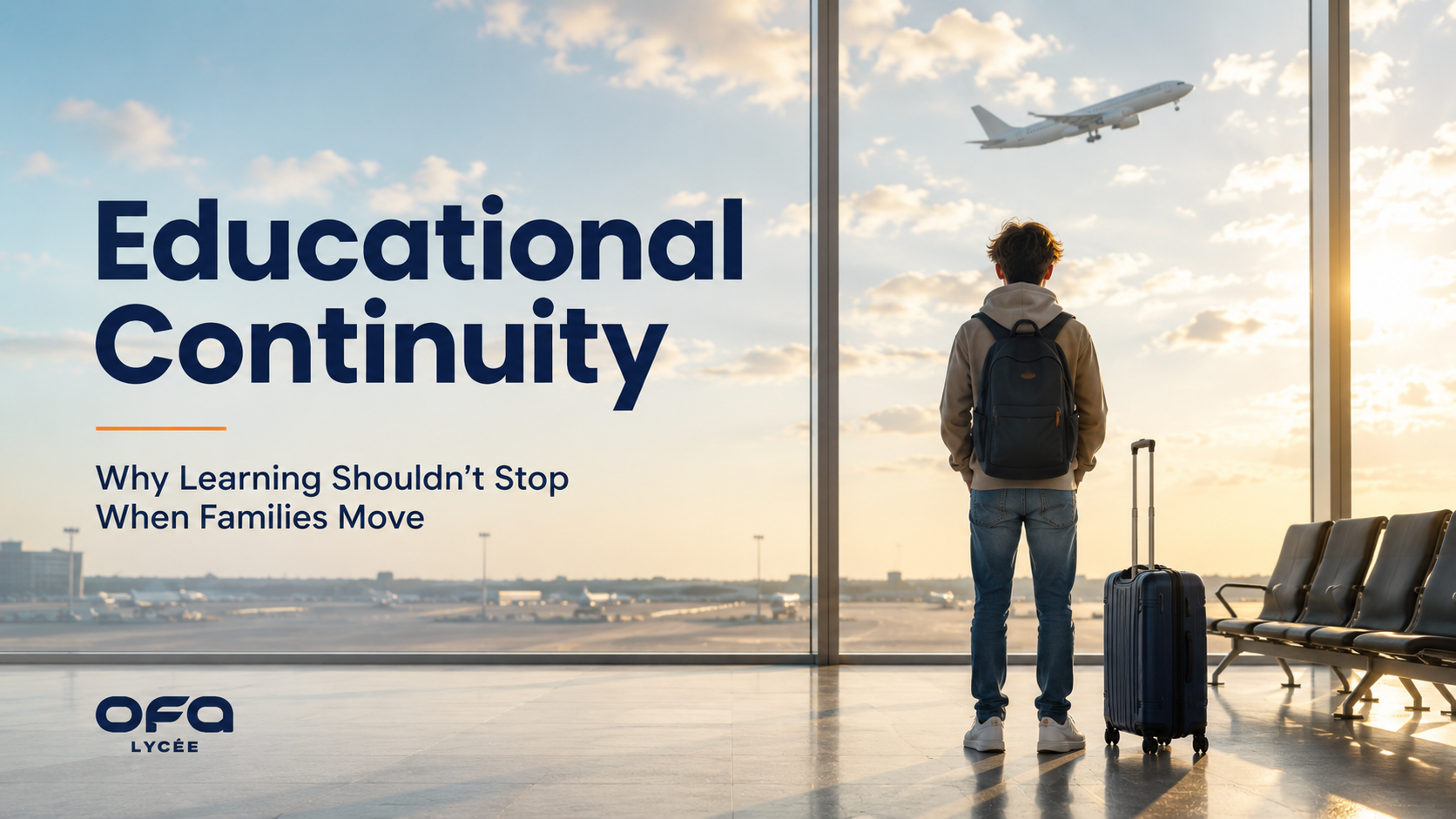
Educational Continuity: Why Learning Shouldn't Stop When Families Move
Children move. Families move. Education should move with them. As international mobility becomes part of everyday life for millions of families, educational continuity is no longer a luxury—it is a necessity. This article explores why transferability matters and why the future of education lies in connecting learning across systems rather than starting over.
REFLECTIONS ON THE FUTURE OF EDUCATION
Educational Continuity: Why Learning Shouldn't Stop When Families Move
For generations, education has been built around a simple assumption. Students begin school in one place, follow one curriculum, and graduate from the same educational system.
For many children, that assumption no longer reflects reality. Every year, millions of families relocate because of work, research, military service, or new opportunities. Children move between countries, languages, and educational systems, sometimes several times before finishing high school. Moving can be an extraordinary opportunity.
Educationally, however, it often comes at a cost.
Over the years, I have worked with hundreds of internationally mobile families. I have watched confident, capable students repeat concepts they had already mastered while discovering unexpected gaps in subjects that were taught differently elsewhere. Some adapted to a new language. Others adapted to a completely different way of learning. Almost all wondered, at some point, whether they were falling behind. Too often, we see this as the student's challenge. I believe it is education's challenge. Our educational systems were designed for stability. Today's families increasingly live in a world defined by mobility. That is why I believe one idea deserves much more attention:
Educational continuity.
Educational continuity does not mean making every curriculum identical. It means ensuring that a child's education continues to make sense, even when life changes. Previous learning should not disappear because a family crosses a border. Progress should not be measured by how well students start over. It should be measured by how well they continue moving forward. This conviction has shaped OFALYCÉE from the very beginning.
Since 2020, we have worked to understand where educational systems overlap, where they differ, and how they can complement one another. Our goal has never been to replace one educational system with another. It has been to help students connect them. Because I believe one of the biggest questions education should be asking today is not:
"How do students adapt to our schools?"
It is:
"How do schools better adapt to students' lives?"
The world has changed.
Families move.
Children adapt.
Perhaps education should, too.
Lectures recommandees
Poursuivez votre exploration sur des sujets similaires

Mon enfant va-t-il perdre une année en rentrant en France ?
« Nous avons peur que notre enfant perde une année scolaire » : cette phrase revient systématiquement lors d'un retour en France. Pourtant, après trente ans d'accompagnement de familles expatriées, ma conviction est claire : on ne perd presque jamais une année, on change simplement de système éducatif.
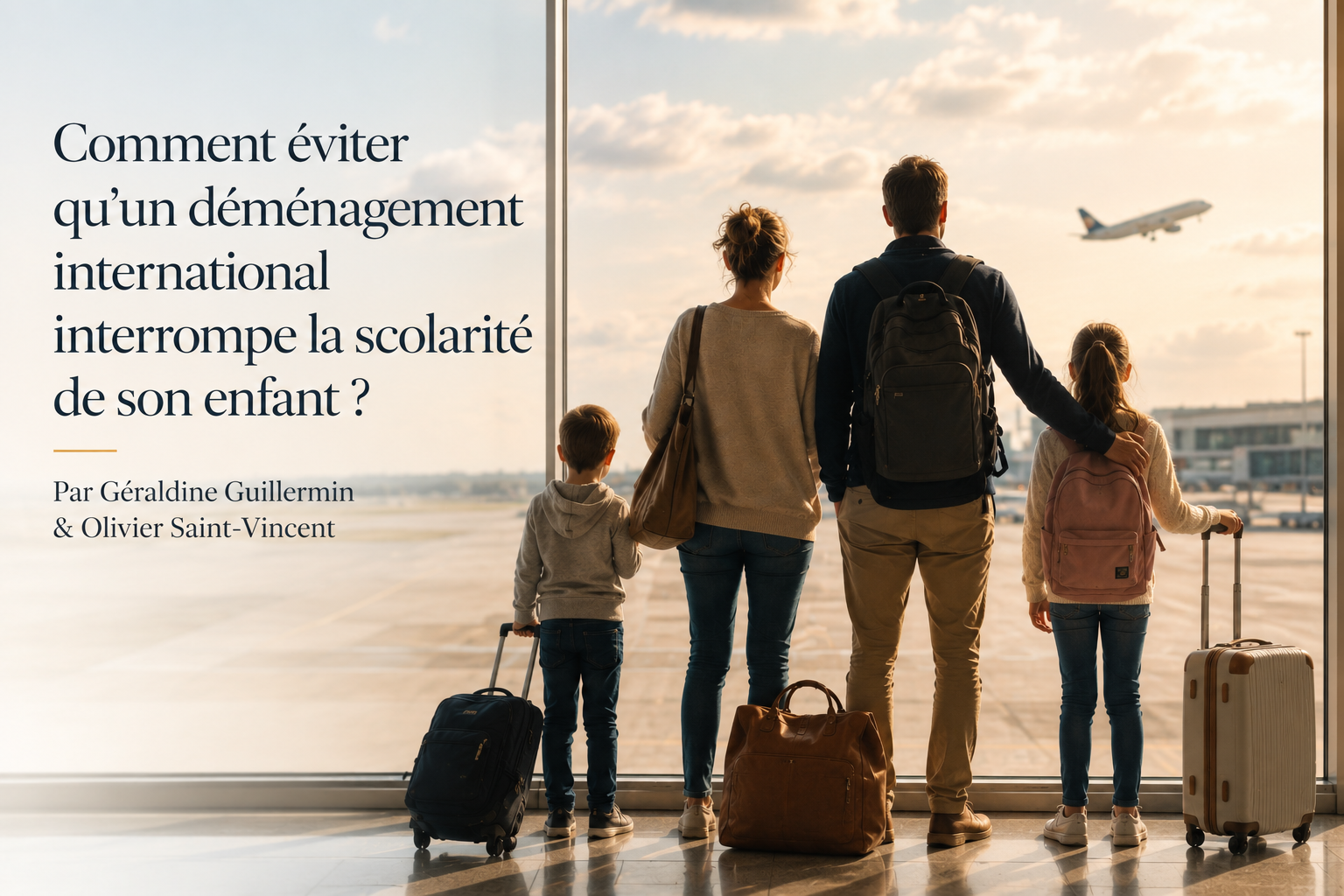
Comment éviter qu'un déménagement international interrompe la scolarité de son enfant ?
Un déménagement international ne fragilise presque jamais la scolarité d'un enfant : c'est l'absence de continuité qui pose problème. Découvrez comment préserver un parcours cohérent pour votre enfant malgré les changements de pays, de langue et de système scolaire.

Comment préparer le retour dans le système scolaire français après une scolarité à l’étranger ?
De nombreuses familles françaises et bilingues se demandent si leurs enfants pourront réintégrer le système scolaire français après plusieurs années de scolarité à l’étranger. Oui, c’est possible, mais la réussite du retour dépend largement du maintien d’un bon niveau de français académique et de l’anticipation des démarches administratives, en particulier à partir du collège et du lycée.

Quand la scolarité française devient le meilleur investissement éducatif
Et si maîtriser le français ouvrait la porte aux universités européennes à 300 euros par an, contre plus de 50 000 dollars aux États-Unis ? Pour les familles bilingues américaines, l'investissement dans une scolarité française devient un calcul économique imparable — et une stratégie éducative que peu osent encore exploiter.
Live Exceptionnel : D'OFALycée à Cambridge !
Rencontre inspirante avec Lea Milanini, ancienne élève à Cambridge University.

Une éducation véritablement sans frontières
Comment OFALycée offre une éducation sans frontières géographiques.